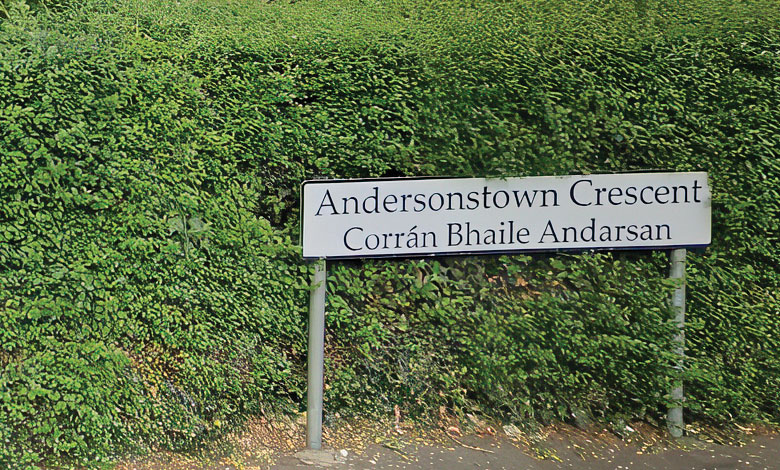
Belfast City Council’s (BCC) new Dual Language Street Sign Policy has led to an increase in approved street signs but the annual budget is insufficient to process applications and erect signage, writes Ciaran Brennan.
Under the current policy, in effect since July 2022, 256 streets have been approved for dual language street signs. This represents an 11.8 per cent increase from the 229 approved throughout the duration of the previous policy administered between 1998 and July 2022. Every single sign approved under the new policy is for Irish. Under the previous policy, 226 were for Irish and three were for Ulster Scots.
BCC has processed 491 applications to date under the new policy with an approval rate of 52 per cent. As of 19 August 2025, there were 1,271 pending applications for dual language street signs across 829 individual streets in the city. Based on the 52 per cent approval rate for previous applications, an estimated 661 applications could be approved. Pending applications are for the following languages:
- Irish: 958
- Ulster Scots: 295
- No language specified: 9
- Hebrew: 2
- Japanese: 2
- Chinese: 1
- Chinese Mandarin: 1
- German: 1
A spokesperson for BCC states that signs have been verified on sites as having been erected in 201 streets. BCC also revealed that the Building Control Service has an annual budget of £67,339 for the supply, erection, repair, and maintenance of all street name plates in Belfast.
In October 2020, a report provided to the Council’s Strategic Policy and Resources Committee estimated the cost of approving and erecting a dual language street sign at £1,089. This was broken down into £568 for staff costs, £273 for postage and printing, and £248 for the cost of the signage.
Should 661 applications be approved as estimated above, it would cost approximately £719,829, while rejected applications would cost approximately £513,010; a total cost of £1.2 million. This is the equivalent of just under 18 years of the Council’s current budget for the supply, erection, repair, and maintenance of all street name plates in Belfast.

The BCC spokesperson states: “We are processing all outstanding applications in line with the policy, and as quickly as our current resources permit.”
Policy changes
The previous dual language street sign policy required a petition with support from one-third of the street’s occupiers. A follow-up consultation required support from two-thirds of occupiers for the application to proceed. Non-replies were deemed as opposed to the application.
Under the new policy, applications are subject to an initial assessment by the People and Communities Committee “to consider any potential adverse impact on the grounds of equality of opportunity, good relations, and rural needs”. Councillors representing the district electoral area are also notified to identify potential “adverse impacts”. A report of potential adverse impacts is provided to the Committee to seek approval to proceed to the survey of occupiers.
This aligns with the European Charter for Regional and Minority Language to which the UK is a signatory. Irish and Ulster Scots are recognised minority languages under the charter which stipulates that signatories cannot create barriers in respect of the use of a minority language.
The survey’s approval threshold has also been lowered to 15 per cent, and non-replies are not deemed opposition. This is based on the UN’s 2017 Special Rapporteur, Language Rights of Linguistic Minorities, which states that between 5 and 20 per cent of the local population must support dual language signs for it to be “practicable and reasonable” to provide them. BCC makes the final decision on an application following a survey.
Lessons
Conradh na Gaeilge President Ciarán Mac Giolla Bhéin tells agendaNi: “BCC has one of, if not, the most minority-compliant street signage policy across the North.”
Mac Giolla Bhéin states that the 15 per cent threshold has been “absolutely transformational in increasing the visibility of the Irish language” in Belfast city. He says that this visibility is crucial to increase “tolerance, acceptance, and understanding of the language”.
However, he also illustrates what he calls BCC’s “haphazard” implementation of the policy: “From the allocation of no extra resources to prepare for the policy change, to the capacity of officials to deal with the influx of applications, to the extensive waiting times, to the signs being erected with spelling mistakes, to the most recent debacle with Royal Mail. There are certainly lessons to be learned.”
In August 2025, an investigation found that around 375 responses to surveys for signs were being held at Royal Mail’s delivery centre, while an unconfirmed number was sent through by the organisation to its return centre. No dual language street sign requests were on the agenda for the August meeting of the Committee due to the hold-up.
Mac Giolla Bhéin also criticises the initial screening assessment to identify potential adverse impacts for using what he asserts is “an undefined set of criteria”. He argues that “intolerant or sectarian views” are “legitimised” by this assessment, adding that opposition to the Irish language and dual language signage is interpreted as an “adverse impact”.
“It has no impact on those who do not want to engage with it. No right exists in domestic or international law not to see a language, however, denial of the Irish language on signs is a denial of language rights,” he adds.