Councils struggling with decreasing income and rising expenditure

Northern Ireland’s local councils are grappling with rising financial pressures, declining income, and growing workforce challenges, according to the Local Government Auditor’s Report 2024.
Covering the 2022/23 financial year, the annual review paints a mixed picture of local government performance, with progress in governance offset by challenges around long-term financial resilience and staffing.
The review, published in October 2024, asserts that councils collectively reported the largest income-expenditure gap since the 2015 reform, with a shortfall of £128 million – equivalent to 11 per cent of expenditure. The shortfall has been driven by falling income, particularly a sharp 54 per cent decline in government grants, alongside rising operational and staffing costs.
Despite efforts to maintain service levels post-pandemic, income from service charges and fees continued to fall for a second consecutive year. Capital investment also remains below pre-Covid levels, reflecting the strain on council finances and increasing uncertainty around large-scale infrastructure projects.
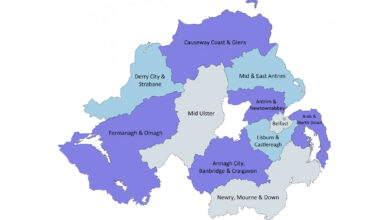
Staff costs account for 39 per cent of council budgets, totalling £436.2 million, with an additional £37.6 million spent on agency staff. Two councils – Causeway Coast and Glens and Mid and East Antrim – are identified as having particularly high reliance on agency workers.
Sickness absence is an escalating challenge, with an average of 16.9 days lost per employee – 37 per cent higher than in the Northern Ireland Civil Service. Councils have also highlighted acute difficulties recruiting and retaining staff in key roles including planning, procurement, and environmental health.
While all councils received unqualified audit opinions, a number of critiques are raised in the report for challenges such as outdated policies, weaknesses in procurement, and underreporting of fraud. Notably, the report states that there are continued delays in meeting statutory planning targets, with only 36.8 per cent of major planning applications processed within the required 30 weeks.
Speaking upon publication, Local Government Auditor Colette Kane said: “This gap between decreasing levels of income and rising expenditure is being experienced across most councils. I am concerned that any sustained continuation of this trend could potentially challenge the long-term financial sustainability of the overall local government sector. Financial resilience, through effective planning and strong oversight, will be crucial in the period ahead, and my report makes several recommendations in this regard.
“The data I have analysed shows that the income generated by councils, through charges and service fees, fell in both of the last two financial years. There may be merit, therefore, in councils considering the scope for increasing income generation, and for sharing details about initiatives they have taken or plan to take to maximise income going forward.
“My report also observes that the value of usable reserves held by councils continues to be higher than before the pandemic, totalling around £447 million in 2022/23. It is essential that councils have clear and robust plans in place for managing and using these reserves in a way that delivers maximum value and benefit for ratepayers.”